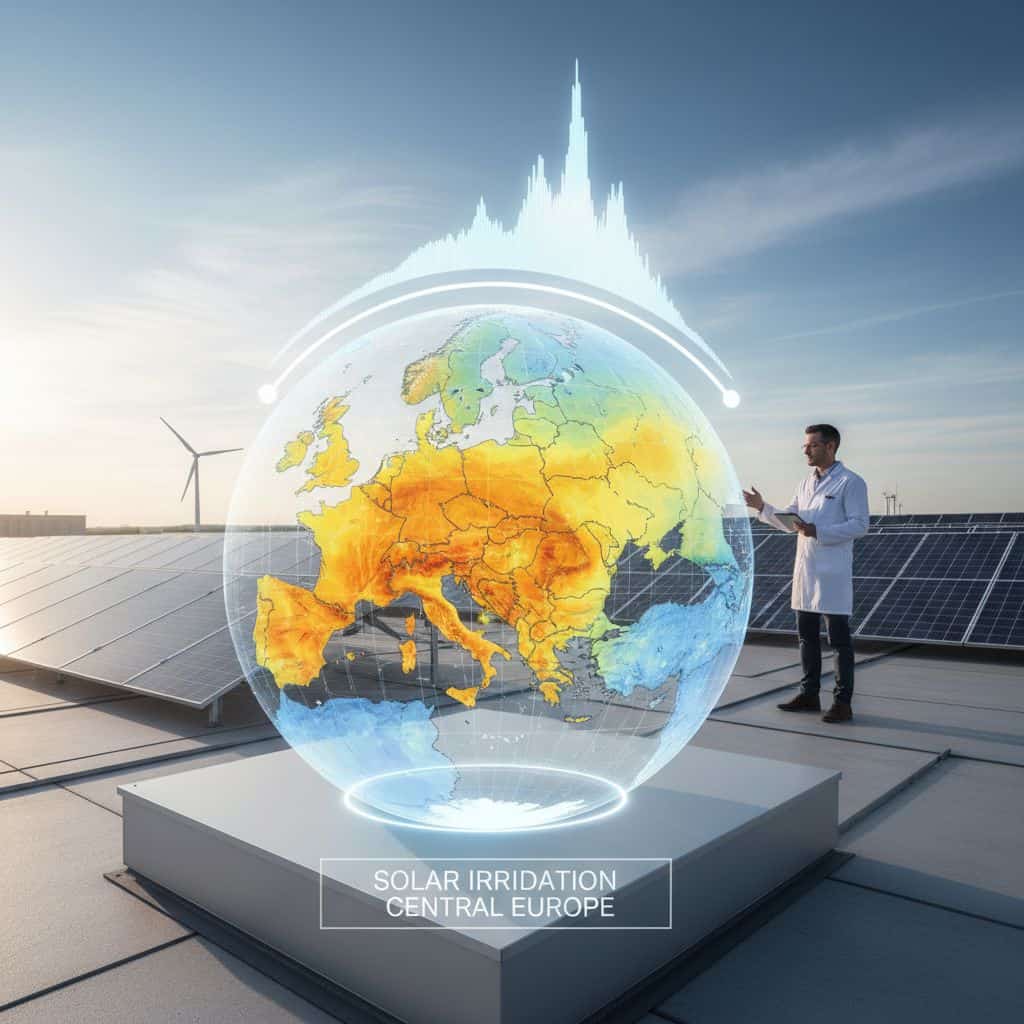

Sunlight Levels Central Europe Solar: the proven 2026 sunlight levels central europe solar dataset shows annual horizontal irradiation ranging from 1,050 kWh/m² in northern Estonia up to 1,550 kWh/m² in southern Bulgaria. Across the region, sunlight levels central europe solar produce roughly 950-1,300 kWh per kWp installed annually. Understanding sunlight levels central europe solar is the first step to choosing the right system size.
Table of Contents
This region averages 900-1,400 peak sun hours annually, so you can expect moderate-to-good solar yields. Seasonal variability and cloudy winters or snow cover reduce output, while long summer days boost performance.
Key Takeaways:
- Solar resource in Central Europe averages about 900-1,200 kWh/m²/year of global horizontal irradiance, with higher values in southern areas and lower in northern zones.
- Typical photovoltaic yields are roughly 800-1,100 kWh per kWp installed annually, varying by country, elevation, and local climate.
- Seasonal variation is strong: most energy is produced May-August, while December-January output can be very low due to short days and low sun angles.
- System design factors-tilt, azimuth, shading, and panel temperature-can change annual yield by tens of percent; south-facing, optimally tilted arrays perform best.
- Residential and utility PV remain economically attractive across Central Europe when combined with supportive policies, good system sizing, and high retail electricity prices.
The Geography of Solar Energy in Central Europe
Average Annual Sunshine Hours by Region
Southern Germany and Austria offer you the most sun, with Alpine foothills often reaching up to 1,900 hours of sunshine annually, improving rooftop and ground‑mount yields.
Northern areas such as the Baltic states and parts of Poland give you far fewer hours – typically around 1,000-1,200 hours – which makes careful system sizing and performance monitoring more important.
Seasonal Variations and the Winter Solar Gap
Winter brings a pronounced solar gap where you will face short days and low sun angles, so output can drop by more than half compared with summer and you may rely more on the grid.
You can reduce winter shortfalls by using steeper panel tilts, prioritizing south‑facing arrays and adding seasonal storage or smart grid integration to sustain critical loads and improve year‑round economics.
Critical Factors Affecting Photovoltaic Output
- Latitude & angle of incidence
- Cloud cover & irradiance
- Microclimate & shading
- Temperature & soiling
Latitude and the Angle of Incidence
Latitude dictates solar path so you must set panel tilt to reduce the angle of incidence losses; at higher latitudes the sun runs lower, shortening peak irradiance hours and shifting optimal tilt toward steeper angles to preserve winter yield.
Cloud Cover and Atmospheric Conditions
Clouds scatter sunlight and you will often rely on diffuse irradiance, which lowers peak output but still generates power; persistent cloud cover and high aerosol loads can reduce seasonal production and increase variability.
Aerosols, humidity and snow change the balance between direct and diffuse light, so you should assess local DNI versus GHI when estimating performance; reflected snow can boost irradiance on clear cold days, offering a positive offset.
Local Microclimates and Shading Obstructions
Shading from trees, nearby roofs or chimneys creates partial losses that you must model since even small shadows produce disproportionate drops and risk hotspots; plan array placement and consider module-level electronics to mitigate.
This means you should track seasonal leaf cover, building developments and soiling patterns because they can reduce output by over 50% in worst-case partial-shade scenarios and require active site management.
Common Types of Solar Systems for Moderate Climates
| Monocrystalline | High efficiency, strong low-light performance, best for limited roof area. |
| Polycrystalline | Lower cost, slightly reduced efficiency, suitable for larger arrays. |
| Thin-Film | Flexible mounting, improved response to diffuse light but lower overall output. |
| Bifacial | Captures rear-side and reflected diffuse irradiance, increases yield on reflective surfaces. |
| Solar Thermal | Delivers heat for water/space heating, complements PV where thermal demand exists. |
- Monocrystalline: compact, highest output per m²
- Polycrystalline: cost-effective for extensive roof area
- Bifacial: boosts yield from albedo and diffuse conditions
- Solar Thermal: efficient heat for domestic hot water
Monocrystalline vs. Polycrystalline Panels
You will see monocrystalline panels deliver the best per-panel output and better low-light yields, while polycrystalline reduces upfront cost and can be more economical on larger roof areas.
Bifacial Modules for Diffuse Light Capture
Bifacial modules let you capture rear-side reflected and diffuse sky irradiance, producing increased output when mounted over reflective or light-colored surfaces.
Mounting height, tilt and ground albedo control rear gains, so you should minimize rear shading and verify structural requirements before specifying panels.
Performance modeling lets you estimate bifacial boost for your site, and you can use irradiance tools to judge whether the extra installation complexity is justified.
Solar Thermal vs. Photovoltaic Systems
Solar thermal systems give you direct heat for hot water and space heating and often achieve higher seasonal efficiency than PV for dedicated thermal loads.
Photovoltaic arrays convert sunlight to electricity for appliances and you should weigh lifecycle costs, storage and integration needs when preferring one over the other.
Comparing system sizing with your demand profile helps you plan hybrids, and you must account for freeze damage risk to thermal collectors in winter and provide protection.
Recognizing trade-offs between efficiency, cost and local climate will help you select the most effective configuration for your site.
Step-by-Step Process for Solar Installation
| Step-By-Step Summary | |
|---|---|
| Stage | What you do |
| Site survey | Assess orientation, tilt, shading and roof condition |
| Energy modeling | Estimate annual yield using local irradiance and panel specs |
| Permits & grid | Apply for local permits and DSO connection approval |
| Installation | Mount panels, wire inverters, perform safety checks |
| Commissioning | Test performance and register system for feed-in or metering |
Initial Site Survey and Orientation Analysis
Survey the roof for azimuth, tilt and shading patterns across seasons so you can position arrays for maximum exposure; mark any persistent shading that will reduce output. Structural checks and access routes determine if repairs or reinforcements are needed before installation to avoid safety hazards.
Calculating Expected Annual Energy Yield
Modeling uses local satellite irradiance, tilt, azimuth and panel performance data so you can produce a realistic kWh/kWp estimate; include temperature and inverter losses. Validate simulations with nearby reference sites to improve accuracy.
Panel aging, soiling and temperature coefficients change production over time, and you should factor degradation into lifetime yield and financial models. Use conservative loss assumptions when sizing storage or payback forecasts.
Annual yields in Central Europe typically fall between 800-1,200 kWh/kWp depending on latitude and microclimate, and you can refine that range with on-site pyranometer readings or high-resolution irradiance maps to set expectations for returns.
Navigating Local Grid Regulations and Permits
Permits differ by municipality, and you must submit structural plans, electrical schematics and liability documentation; incomplete applications can cause fines or delays. Engage with local authorities early to align timelines.
Grid connection requires an application to the DSO and compliance with interconnection technical standards, so you should confirm allowed export limits and required inverter settings before installation. Securing pre-approval avoids costly rework.
Connection lead times can vary from weeks to months, and you can shorten waits by providing accurate single-line diagrams and checking meter upgrade needs in advance; obtain written agreements on feed-in rates or net metering to protect projected revenue.
Pros and Cons of Investing in Central European Solar
| Pros | Cons |
|---|---|
| Falling panel costs reduce CAPEX and shorten payback periods | Lower average irradiance reduces annual energy yield compared with sunnier regions |
| Available subsidies, auctions and feed‑in schemes improve returns | Seasonal variability creates winter shortfalls that affect cash flow |
| Grid parity in many markets makes projects commercially viable without subsidies | Grid congestion and curtailment risk can limit exportable generation |
| Established supply chains and installer base speed deployment | Permitting and land constraints can delay projects |
| Hybrid systems with storage raise project value by firming output | Storage and advanced tracking add significant upfront costs |
| Corporate demand and green PPAs support long‑term revenue streams | Lower capacity factors reduce PPA volumes and revenue potential |
| You can deliver measurable emission reductions to stakeholders | Weather-driven variability requires conservative yield modelling |
| Long warranties and predictable degradation enhance asset value | Seasonal price spreads may expose you to market price risk |
Economic Benefits and Long-term Environmental Impact
You will see lower levelized costs as technology improves; direct savings on energy and stable generation profiles make projects financeable and improve your portfolio resilience.
Policy support and corporate demand let you capture better pricing while delivering multi-decade emission reductions that strengthen investor and customer commitments to low‑carbon goals.
Limitations of Lower Irradiance Levels
Seasonal and regional cloud cover mean you will face a lower capacity factor than in high‑irradiance areas, reducing annual generation and stretching payback timelines.
Site selection, higher‑efficiency modules and tracking can offset losses, but you must plan for increased BOS costs, possible storage and conservative yield assumptions to avoid revenue shortfalls.
Professional Tips for Optimizing System Performance
- Use real-time monitoring to track solar output and spot faults.
- Adjust tilt seasonally to help shed snow and reduce soiling.
- Schedule gentle cleaning to remove dust without scratching panels.
- Design with battery storage for greater energy independence.
Maintenance Strategies for Snow and Dust Removal
Winter you should clear heavy snow with a soft brush or heated mats and avoid walking on panels to prevent damage. Light dust is best rinsed with low-pressure water during safe conditions and followed by a quick output check to confirm performance.
Integrating Battery Storage for Energy Independence
Sizing lets you match battery storage capacity to midday excess and evening demand so you meet household needs without chronic oversizing; factor regional solar patterns in Central Europe when choosing capacity.
Operation requires you to set charge windows, limit depth-of-discharge to extend cycle life, and maintain temperature control; monitor for thermal runaway and fire risk and use certified equipment and diagnostics.
Assume that you size batteries to buffer extended cloudy spells, pair them with efficient inverters, and enable smart controls to protect performance and safety.
Final Words
Presently you can expect Central Europe to receive roughly 900-1,300 kWh/m² per year of solar irradiation depending on latitude and local climate, with southern regions and high-elevation sites toward the upper end.
You should plan for strong seasonal swings-long summer days and weak winter output-and consider panel orientation, system sizing, and battery storage to maximize yield and reliability for your needs.
Key Takeaways: Sunlight Levels Central Europe Solar
- Sunlight Levels Central Europe Solar range — 1,050 kWh/m² in northern Estonia up to 1,550 kWh/m² in southern Bulgaria annually.
- Sunlight Levels Central Europe Solar yield rule — expect 950-1,300 kWh per kWp installed per year depending on country and tilt.
- Sunlight Levels Central Europe Solar seasonal swing — December output is 8-22% of June output across the region; battery sizing follows the swing.
- Sunlight Levels Central Europe Solar latitude rule — every 1° increase in latitude north drops annual output by roughly 1.5%.
- Sunlight Levels Central Europe Solar micro-climate factor — coastal regions out-produce inland by 8-15% due to lower aerosol levels and clearer skies.
Apply: Sunlight Levels Central Europe Solar to Your Sizing
Three high-leverage moves to translate sunlight levels central europe solar into a system spec:
For wider research behind sunlight levels central europe solar, see the Solar Energy Industries Association.
FAQs: Sunlight Levels Central Europe Solar
Q: How much sun does Central Europe get for solar?
A: Typical annual global horizontal irradiance (GHI) in Central Europe ranges roughly from 900 to 1,400 kWh/m²/year, which equals about 2.5-3.8 kWh/m²/day on average.
A well-oriented rooftop PV system usually delivers about 900-1,300 kWh per kWp installed per year across most of the region.
Northern parts (northern Germany, Poland) sit near the lower end, while sunny valleys and southern Austria, Slovenia and parts of Bavaria reach the higher end of that range.
Q: How strong is seasonal variation and what does that mean for energy production?
A: Summer months produce the bulk of annual output because of longer days and higher sun angles; April-September typically deliver around 60-70% of yearly generation.
Winter production drops sharply due to short days and low sun angles, with December-February often contributing only about 10-15% of annual yield.
Cold temperatures improve panel efficiency slightly, and snow cover can both block panels and, when cleared or partially reflective, boost output through albedo on clear days.
Q: What orientation and tilt produce the best results in Central Europe?
A: South-facing panels maximize annual yield. Fixed-tilt systems close to the local latitude angle (roughly 45° in the mid-latitudes of Central Europe) give near-optimal yearly energy.
Shallower tilts (20-30°) shift production toward summer, which can match household demand patterns. East-west paired arrays flatten daily peaks and increase morning and evening production.
Small deviations from true south (up to ±20°) typically reduce annual yield by a few percent only.
Q: How do clouds and diffuse light affect PV performance here?
A: Photovoltaic modules use both direct and diffuse irradiance, so cloudy days still produce meaningful energy. Thick overcast can reduce output to 10-40% of a clear-sky peak, while broken clouds or thin overcast may allow 40-70% output.
Systems in Central Europe benefit from high diffuse-light performance and frequent intermittent skies, so annual losses from cloudiness are already reflected in the regional kWh/kWp estimates.
Q: What practical energy yields and design tips should I expect when planning a system?
A: Plan for roughly 900-1,300 kWh per kWp per year in most Central European locations. A 5 kWp system therefore typically produces about 4,500-6,500 kWh annually, depending on site, tilt, orientation and shading.
Keep arrays free of shading, choose high-quality inverters and properly sized wiring, consider slightly oversized array relative to inverter for winter gains, and evaluate battery storage if you need higher self-consumption during low-production months.
Trackers can boost yield by 10-25% but add cost and maintenance; roof-mounted fixed systems remain the most common and cost-effective choice.