TL;DR: Monocrystalline vs polycrystalline comes down to efficiency versus price. This monocrystalline vs polycrystalline guide compares output, cost, lifespan, and looks so you pick right.
Table of Contents
Solar panel choice affects your system: you get higher efficiency and space savings with monocrystalline, lower cost with polycrystalline, and you must watch for heat-related performance loss that can reduce output.
Key Takeaways:
- Monocrystalline panels deliver higher efficiency (typically 18-22%) and greater energy output per square foot, making them ideal for limited roof space.
- Polycrystalline panels cost less per watt with lower efficiencies (typically 15-17%), offering better value when roof area is abundant and budget is tight.
- Monocrystalline usually has a better temperature coefficient and slightly lower degradation, improving performance in hot or low-light conditions.
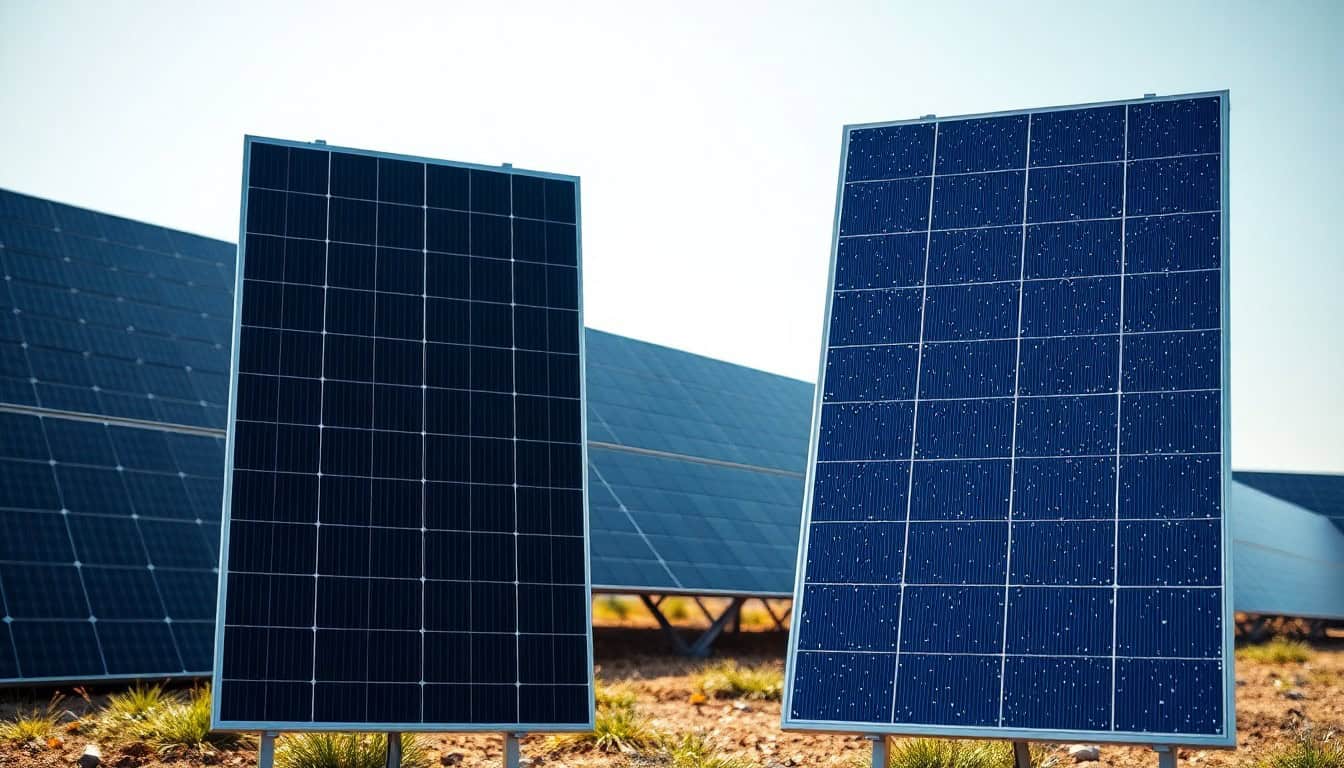
- Appearance differs: monocrystalline panels are uniformly dark/black while polycrystalline panels have a blue, speckled look that affects residential aesthetics.
- Select based on budget, available area, aesthetic preference, and warranty/performance trade-offs; compare local prices and manufacturer warranties before deciding.
Understanding Solar Cell Technologies and Material Types
Solar Cell Types
| Monocrystalline | Single-crystal silicon; highest efficiency, higher cost |
| Polycrystalline | Multiple-crystal silicon; lower cost, reduced efficiency |
| Thin-film (a‑Si, CdTe) | Flexible, lightweight; lower efficiency, niche uses |
| PERC / Advanced Mono | Improved rear passivation; higher output per cell |
| Bifacial | Generates from both sides; adds yield in reflective environments |
- Monocrystalline
- Polycrystalline
- Efficiency
- Cost
- Aesthetics
The Manufacturing Process of Monocrystalline Silicon
Czochralski growth pulls a single silicon crystal from molten silicon to form an ingot you slice into wafers, producing a uniform lattice that yields higher efficiency and consistent performance while generating kerf waste during slicing.
The Composition and Structure of Polycrystalline Cells
Multiple crystals form when molten silicon is cast into square molds, producing grain boundaries that you will see as a speckled texture and that cause electron scattering, lowering cell efficiency compared to mono.
You will find that polycrystalline cells often use less-refined feedstock and simpler casting, which reduces manufacturing complexity and delivers a lower price point for system buyers.
Compared with monocrystalline, polycrystalline tolerates recycled silicon and simpler equipment, so you trade some performance for cost savings and reduced material processing.
Comparing Aesthetic Appeal and Physical Footprint
Visually, monocrystalline panels appear uniformly dark and compact, while polycrystalline panels show a blue-speckled pattern that you may find less sleek on visible roof sections.
Panels based on monocrystalline cells typically provide more watts per square meter, so you will need more polycrystalline area to achieve the same output, affecting roof layout and shading decisions.
Appearance vs Footprint
| Monocrystalline | Uniform dark look; smaller footprint per watt |
| Polycrystalline | Speckled blue finish; larger area required for equal power |
| Installation | You weigh visual preference against available roof space and budget |
The table clarifies the trade-offs so you can weigh efficiency, cost, and appearance when choosing between panel types.
Critical Performance Factors and Technical Specifications
Energy Conversion Efficiency and Power Output
Efficiency defines how much sunlight you convert into usable electricity; Monocrystalline typically reaches about 18-22% while Polycrystalline averages around 15-17%, so you will get more watts per square meter with mono panels.
- Monocrystalline: higher efficiency, smaller footprint
- Polycrystalline: lower cost per panel, larger area needed
- You should compare module wattage, roof area, and budget
Temperature Coefficient and Performance in High Heat
Heat reduces output and you must check the temperature coefficient; Monocrystalline often shows around -0.35%/°C while Polycrystalline can be nearer -0.45%/°C, meaning poly may lose more power as temperatures climb.
Temperature Effects Comparison
| Metric | Typical Impact |
|---|---|
| Temp coefficient | Mono ~-0.35%/°C · Poly ~-0.45%/°C |
| Output drop per 10°C | Mono ≈3.5% · Poly ≈4.5% |
Measure expected operating temperature and multiply by the coefficient so you can estimate seasonal losses and decide if Monocrystalline pays off in hotter sites.
Durability and Expected Lifespan Standards
Longevity is expressed via performance warranties and degradation rates; you should expect 25-30 year warranties, with Monocrystalline often degrading ~0.5%/yr and Polycrystalline ~0.6-0.8%/yr, affecting long-term yield.
Durability Metrics
| Metric | Typical Value |
|---|---|
| Warranty | 25-30 years performance guarantee |
| Annual degradation | Mono ~0.5% · Poly ~0.6-0.8% |
| Expected useful life | 25+ years with gradual output decline |
After you compare warranties, independent test results, and manufacturer PID and salt/fog certifications, you can choose the panel type that best matches your risk tolerance and site conditions.
Weighing the Pros and Cons of Each Technology
Pros and Cons: Monocrystalline vs Polycrystalline
| Monocrystalline | Polycrystalline |
|---|---|
| Higher efficiency (more output per sqft) | Lower cost per watt |
| Space-saving-fewer panels needed | Requires more area for same output |
| Better temperature coefficient-performs better in heat | Worse temp coefficient-more loss in heat |
| Uniform black appearance, often preferred | Speckled blue look, less sleek |
| Marginally longer warranties | Reliable with satisfactory lifespan |
| Higher silicon waste in production-more environmental impact | Simpler manufacturing-less waste |
| Better partial-shade performance | More sensitive to shading-larger output drop |
| Widely available in premium models | Easy to source as budget option |
| Faster payback on limited roofs due to efficiency | Lower upfront outlay can shorten payback on large roofs |
| Higher upfront price | Better for cost-constrained projects |
Advantages and Drawbacks of Monocrystalline Panels
You will benefit from higher efficiency and a stronger temperature coefficient, so panels deliver more power per square meter and hold up better in heat. Manufacturing adds cost and creates more silicon waste, so you trade higher upfront expense for compact installation and often quicker returns on constrained roofs.
Benefits and Limitations of Polycrystalline Systems
Polycrystalline gives you a lower upfront cost and simpler production, making it attractive for large, budget-sensitive installs. You should expect lower efficiency and a weaker temperature coefficient, so more panels and roof area are required to match monocrystalline output.
Expect that you save on purchase price and reduce production waste, but you sacrifice space and peak output; budget-conscious buyers often accept the efficiency gap when roof area is abundant.
Professional Installation and Maintenance Tips
Skilled installers will align array spacing, select appropriate mounts, and verify wiring to reduce hotspots and electric shock risks; you should insist on teams experienced with both Monocrystalline and Polycrystalline panels, check warranty coverage, and confirm performance testing before sign-off.
- Use certified installers and obtain detailed installation records
- Verify roof penetrations and flashing to prevent leaks
- Test voltages, grounding, and rapid shutdown systems
- Install monitoring to detect early degradation
- Maintain clear access for inspection and emergency shutoff
Strategies for Optimizing Panel Placement and Tilting
Position panels to minimize shading and set tilt near your latitude, adjusting seasonally if feasible; choose Monocrystalline for higher efficiency in limited space and Polycrystalline when area allows, and add optimizers to reduce losses from partial shade.
Routine Maintenance to Prevent Power Degradation
Inspect panels quarterly for soiling, bird droppings, loose clamps, and inverter fault codes, and monitor output trends so you can spot degradation early and address hotspots or damaged junctions before they pose a fire risk.
Clean panels with low-pressure water and soft brushes, keep vegetation trimmed, and schedule an annual professional check of wiring and seals. After you record baseline performance, compare monthly output and prioritize repairs when production drops beyond warranty thresholds.
Monocrystalline vs Polycrystalline Solar Panels – Which Is Better
Upfront Cost Comparison vs. Lifetime ROI
Monocrystalline panels carry a higher upfront cost but deliver higher efficiency, so you can recover expenses faster when roof space is limited; factor installation, inverter replacements, and annual degradation into your lifetime ROI calculation to see which option truly saves you money.
Cost vs ROI Snapshot
| Monocrystalline | Polycrystalline |
|---|---|
| Higher upfront cost, higher output per m² | Lower upfront cost, larger area needed |
| Better ROI on constrained roofs, slower payback if priced high | Slower ROI on small roofs, may win on total system cost |
| Lower degradation, longer effective life | Moderate degradation, shorter effective lifespan |
Navigating Incentives, Rebates, and Tax Credits
Check federal and state incentives before you buy because the 30% federal ITC and local rebates can materially reduce your net cost and shorten payback; confirm eligibility windows and application steps to capture maximum savings.
Compare how programs calculate benefits: output-based rebates favor the higher-efficiency monocrystalline, while capacity-based or flat rebates can make lower-cost polycrystalline more attractive; verify whether tax credits transfer if you plan to sell the property so you preserve long-term value.
Summing up
So you should weigh space and budget when choosing panels. Monocrystalline gives higher efficiency and better performance in limited roof area, while polycrystalline offers lower cost and slightly lower efficiency for larger installations.
If you prioritize output per square foot and long-term return, monocrystalline suits you; if upfront cost and simple installations matter more, polycrystalline can fit. Consult installer and assess shading, warranty, and energy goals to decide.
Key Takeaways: Monocrystalline vs Polycrystalline
- Judge monocrystalline vs polycrystalline on efficiency — monocrystalline cells convert more sunlight per square metre.
- Compare monocrystalline vs polycrystalline on cost — polycrystalline panels cost less to make and buy.
- Weigh monocrystalline vs polycrystalline on space — mono wins where roof area is limited.
- Consider monocrystalline vs polycrystalline looks — mono’s uniform black suits many homeowners; poly is bluish.
- Match monocrystalline vs polycrystalline to budget — choose mono for max output, poly for lowest upfront price.
Apply Monocrystalline vs Polycrystalline to Your Choice
Once you settle monocrystalline vs polycrystalline, see the wider panel picture.
- The different types of solar panels
- How efficient are solar panels in 2026
- Solar panels in Slovenia — a full guide
For panel standards behind monocrystalline vs polycrystalline, see the Solar Energy Industries Association.
FAQs: Monocrystalline vs Polycrystalline
Q: What are monocrystalline and polycrystalline solar panels?
A: Monocrystalline panels are made from single-crystal silicon wafers that are sliced from cylindrical ingots and have a uniform dark appearance and higher efficiency.
Polycrystalline panels are produced by casting molten silicon into square molds, creating multiple silicon crystals per cell and a speckled blue look with slightly lower efficiency and lower manufacturing cost.
Q: Which type delivers better efficiency and performance?
A: Monocrystalline panels typically deliver higher efficiency, usually in the range of 18-24%, because a single crystal structure allows electrons to flow more freely.
Polycrystalline panels usually reach 15-17% efficiency and may perform slightly worse in high temperatures and low-light conditions due to grain boundaries that impede electron flow.
Q: Which option is more cost-effective for homeowners?
A: Polycrystalline panels cost less per panel because their manufacturing process wastes less silicon and is simpler, making them attractive for large, cost-sensitive installations.
Monocrystalline panels cost more upfront but provide higher power per square meter, so they can be more economical when roof space is limited or when aiming to maximize energy from a small area.
Q: How do durability and warranties compare between the two types?
A: Both types commonly carry warranties of 20-25 years and can last 25-30 years or longer with proper installation.
Monocrystalline panels often show slightly lower annual degradation rates, which means they retain a higher percentage of original output over time, while polycrystalline panels may have marginally higher degradation but still offer long service life.
Q: How should I choose between monocrystalline and polycrystalline for my installation?
A: Evaluate roof space, budget, aesthetic preference, and local climate; choose monocrystalline if space is limited, appearance is important, or maximum efficiency is required, and choose polycrystalline if budget is tight and ample panel area is available.
Consult installer quotes that compare cost per watt, expected energy yield for your location, and warranty terms to make an informed selection.