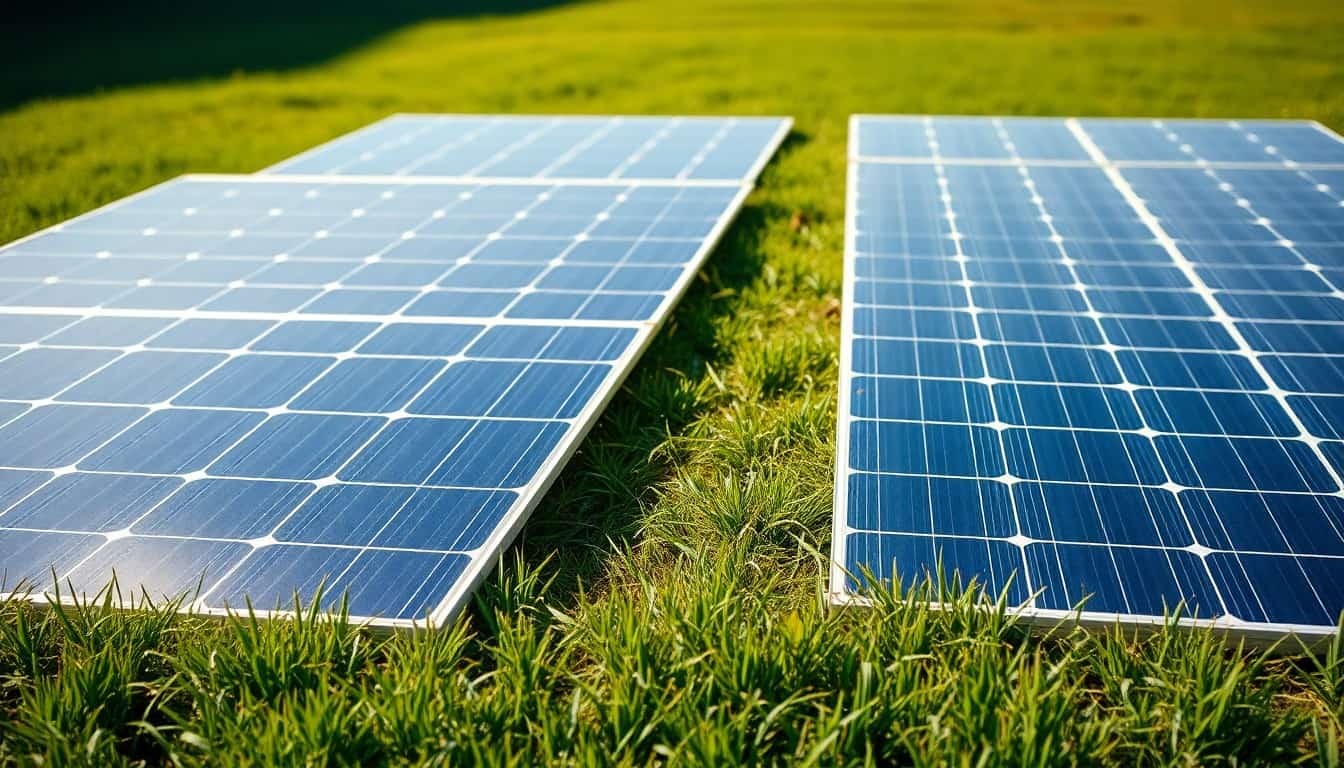
TL;DR: The main types of solar panels are monocrystalline, polycrystalline, and thin-film. This guide compares the types of solar panels on efficiency, cost, and best use case.
Table of Contents
Panels come in several types-monocrystalline, polycrystalline, thin-film-and you should weigh efficiency, cost, and fire and degradation risks before choosing, while professional installation reduces hazards and maximizes performance.
Key Takeaways:
- Monocrystalline panels deliver the highest efficiency and longest lifespan, making them best for limited roof space and long-term performance.
- Polycrystalline panels provide lower cost and simpler manufacturing but have reduced efficiency and require more installation area.
- Thin-film panels offer lightweight, flexible options for curved surfaces and portable systems while sacrificing efficiency and lifespan.
- Bifacial panels generate additional energy by collecting light on both sides, especially effective over reflective or elevated mounts.
- Building-integrated photovoltaics (BIPV) combine solar generation with building materials like tiles or facades for aesthetics, with higher upfront cost and typically lower per-panel efficiency.
Detailed Analysis of Primary Solar Panel Types
- Monocrystalline
- Polycrystalline
- Thin-Film
- Efficiency
- Cost
| Type | Monocrystalline / Polycrystalline / Thin-Film |
| Efficiency | High (mono) / Moderate (poly) / Low (thin-film) |
| Cost | Highest (mono) / Lower (poly) / Variable (thin-film) |
| Best use | Space-limited roofs (mono) / Budget installations (poly) / Flexible or BIPV (thin-film) |
| Notes | Mono: best power density; Poly: cost-effective; Thin-film: lightweight but faster degradation |
Monocrystalline Silicon Panels
Monocrystalline cells deliver the highest efficiency, so you can maximize output on limited roof area and expect a long lifespan.
Panels typically show better low-light performance but come with a higher upfront cost and require careful shading management to avoid hot spots.
Polycrystalline Silicon Panels
Polycrystalline panels offer lower cost and simpler manufacturing, making them a sensible choice when you prioritize budget over absolute efficiency.
Cells perform moderately well in standard conditions, and you should expect slightly lower power density compared with monocrystalline options.
Performance typically ranges around 13-17% efficiency and you can plan for typical warranties near 20-25 years while accepting a modestly higher temperature sensitivity.
Thin-Film Solar Technology
Thin-film options are lightweight and flexible, so you can apply them to curved surfaces or building-integrated projects where weight matters.
Applications include BIPV, portable systems, and large-area installations, although you will trade off lower efficiency for form factor benefits.
Durability varies by chemistry; some types show faster degradation and certain materials carry toxicity concerns, so you must assess lifecycle handling. Assume that you factor in local climate and system sizing when choosing panel type.
Comparing Pros and Cons of Traditional vs. Modern Panels
Pros and Cons
| Traditional Panels | Modern Panels |
|---|---|
| You get lower upfront cost per module but lower efficiency (roughly 15-20%). | You obtain higher efficiency (often 20%+) which saves roof space but costs more initially. |
| You benefit from proven durability and long track records; supply chains are established. | You benefit from improved degradation rates and newer warranties, though long-term field data varies. |
| You may see greater performance loss at high temperatures compared with advanced designs. | You typically experience better temperature tolerance with some modern cell architectures. |
| You face simpler installation requirements, reducing labor risk and complexity. | You encounter more complex installs for bifacial or frameless options; improper fitment can cause hot spots or moisture issues. |
| You handle heavier, more visible panels that can be less aesthetic on homes. | You can choose sleeker or lightweight formats (thin‑film, HJT) that integrate better visually. |
| You work with mature recycling streams but manufacturing still consumes significant energy. | You should verify material sourcing and end‑of‑life plans; some modern types reduce silicon use or improve recyclability. |
Efficiency Ratings and Power Output
You will notice modern panels typically deliver higher wattage per square meter, so you produce more energy on limited roof area and lower your payback time; you should check nameplate and real‑world degradation figures when comparing models.
Installation Costs and Long-term Value
Modern panels often raise your initial system cost, but you can recoup that through higher lifetime yield and extended warranties; you need to run an ROI that includes incentives and local rates.
Calculating total value requires you to factor installation labor, inverter pairing, maintenance and expected annual degradation-choosing higher-efficiency modern panels usually pays off if you have constrained space or high electricity prices, while traditional panels can be sensible where upfront budget is the primary limiter.
What Are the Different Types of Solar Panels
- Monocrystalline
- Polycrystalline
- Thin-film
- Efficiency
- Temperature coefficient
- Net metering
- Incentives
Environmental Conditions and Temperature Coefficients
Environmental Factors
| Condition | Effect |
|---|---|
| High temperature | Reduced output; check temperature coefficient |
| Shading | Disproportionate power loss; consider optimizers |
| Soiling/Humidity | Corrosion and lower efficiency |
Heat reduces most panels’ output, so you should compare manufacturers’ temperature coefficients and prefer panels with smaller negative drops to preserve annual yield in warm climates.
Roof Space Availability and Weight Limits
Panel dimensions and wattage determine how many you can install, so you must measure usable roof area, account for obstructions and orientation, and confirm weight limits with a structural assessment.
Space planning also requires tilt, spacing for maintenance, and roof access; if your roof can’t support the array or lacks area, consider ground mounts or lighter thin-film alternatives.
Local Incentives and Net Metering Policies
Incentives vary by location, so you should catalog federal, state, and utility rebates and verify how net metering credits exported energy to model your payback.
Policies on compensation rates, interconnection rules, and contract duration will affect system sizing and expected payback. Knowing how these rules affect your returns guides the best panel choice.
Advanced Technologies: Bifacial and PERC Panels
- Bifacial modules – let you harvest reflected and diffuse light from the rear surface to increase yield.
- PERC cells – add a rear-passivation layer so you get higher cell voltage and improved efficiency.
- Trade-offs – you must weigh site albedo, soiling risk, temperature behavior, and warranty details when choosing.
Quick Comparison
| Bifacial | PERC |
|---|---|
| How it works: captures front and rear irradiance | How it works: rear passivation improves carrier collection |
| Best where: high albedo surfaces or trackers | Best where: retrofit and new builds needing higher module efficiency |
| Considerations: rear soiling and mounting height | Considerations: module temperature coeff. and long-term stability |
Enhancing Energy Capture with Bifacial Modules
Bifacial modules capture light on both faces so you can increase energy yield from ground reflection and diffuse light; sites with reflective surfaces often deliver up to ~25% additional energy. You must manage rear-side soiling and shading, as those factors can sharply reduce the expected gains.
Understanding PERC Cell Efficiency
PERC cells add a rear-passivation layer so you can extract more current and slightly higher voltage, typically providing a 1-2% absolute efficiency boost. You should evaluate temperature coefficient and potential long-term degradation when comparing module options.
Manufacturers tune passivation and process to balance performance and durability, so you can compare warranties, test data, and temperature behavior to choose the most reliable PERC module for your array.
Step-by-Step Guide to Choosing the Right System
| Step | Action |
|---|---|
| Home Energy Audit | Collect bills, log appliance use, identify peak loads and baseline consumption. |
| Evaluate Manufacturers | Check Tier 1 status, warranties, certifications, and service networks. |
| Finalize Sizing & Layout | Size array from audit, assess shading, choose inverter type, and plan maintenance access. |
Conducting a Home Energy Audit
Begin by gathering your recent utility bills and listing high-use appliances so you can establish an accurate baseline for sizing. You should record hourly or daily usage and note peak demand periods to avoid undersizing the system.
Evaluating Tier 1 Manufacturers
Compare manufacturer warranties, third-party test results, and financial backing so you can prioritize bankability over marketing claims. You should favor suppliers whose warranties are honored locally and have clear degradation guarantees.
Investigate distributor and installer networks to ensure timely replacement and support; long-term serviceability often matters more than initial price. You should verify that the manufacturer has consistent production records and insurance for warranty fulfillment.
Check product certifications (IEC, UL) and independent performance data to confirm module reliability; certified modules reduce the risk of field failures. You should request serial-numbered test reports when possible.
Finalizing System Sizing and Layout
Calculate system capacity from your audited consumption, factoring roof orientation, tilt, and shading so you can meet target offset or export goals. You should size the inverter to match expected array output and future expansion.
Optimize panel placement to minimize shading during peak sun and consider microinverters or optimizers for partial shading scenarios. You should model production with a shading analysis tool before finalizing the layout.
Plan for safe maintenance access, fire-setback requirements, and structural checks to ensure long-term reliability; safe access lowers installer risk and maintenance costs. You should obtain a roof inspection to confirm load capacity before ordering equipment.
Expert Tips for Maximizing Solar Efficiency
You can boost the efficiency of your solar panels by minimizing shading, optimizing tilt, and scheduling regular maintenance. Inspect for debris, check inverter status, and prioritize safety when accessing panels. Hire professionals for roof work and keep records to protect warranties.
- Clear leaves, dust, and bird droppings regularly
- Trim trees to reduce shading
- Monitor inverter lights and error codes
- Use soft brushes and low-pressure water for cleaning
Seasonal Maintenance and Cleaning Protocols
Seasonal care prevents steady loss of output: in winter remove heavy snow carefully to avoid slips, in spring clean pollen buildup, and in fall clear leaves. Use non-abrasive tools and avoid standing on slippery roofs; call a pro if height or slope creates a dangerous situation.
Implementing Smart Monitoring Solutions
Implementing a monitoring system gives you real-time visibility into system performance and quickly flags underperformance or faults. Choose platforms that provide string-level data, mobile alerts, and exportable reports so you can compare production over time and verify warranty claims.
More advanced setups include temperature sensors and AI anomaly detection to find hotspots and inverter inefficiencies; set drop thresholds to trigger alerts. This lets you respond fast to preserve output and maximize long-term efficiency.
Summing up
From above you learned that solar panels fall into main types: monocrystalline for highest efficiency and space-limited roofs, polycrystalline as a lower-cost option, thin-film for flexible or low-weight applications, and bifacial or building-integrated modules for extra yield or aesthetics.
You should weigh efficiency, cost, durability, and installation constraints to choose the best option for your site.
Key Takeaways: Types of Solar Panels
- Compare types of solar panels on efficiency — monocrystalline leads, polycrystalline follows, thin-film trails.
- Weigh types of solar panels on cost — polycrystalline is cheaper up front; monocrystalline pays back on space.
- Match types of solar panels to roof space — high-efficiency panels win when area is tight.
- Consider thin-film types of solar panels — flexible and light, ideal for odd surfaces and low weight.
- Pick types of solar panels by climate — some panel types handle heat and low light better than others.
Apply Types of Solar Panels to Your Project
Once you know the types of solar panels, see which suits your region.
- Monocrystalline vs polycrystalline solar panels
- Solar panels in Slovenia — a full guide
- Best Central European country for solar energy
For panel classification and industry data on types of solar panels, see the Solar Energy Industries Association.
FAQs: Types of Solar Panels
Q: What are the main types of solar panels used for residential and commercial installations?
A: Monocrystalline panels are made from single-crystal silicon and offer the highest efficiency and longest lifespans among common silicon options.
Polycrystalline (multicrystalline) panels are produced from multiple silicon crystals, cost less to manufacture, and provide lower efficiency than monocrystalline.
Thin-film panels include amorphous silicon (a‑Si), cadmium telluride (CdTe), and CIGS (copper indium gallium selenide); these are lightweight, flexible options with lower per-panel efficiency but better performance in diffuse light and high temperatures.
Bifacial panels produce power from both front and rear faces and can increase energy yield when installed over reflective surfaces.
Building-integrated photovoltaics (BIPV) and flexible panels serve dual roles as building materials or portable arrays, trading some efficiency for aesthetics or form factor.
Specialized types such as concentrated photovoltaics (CPV) require optical concentrators and tracking systems and are used in high-insolation utility settings.
Q: How do monocrystalline and polycrystalline panels differ in performance and cost?
A: Monocrystalline panels typically deliver higher conversion efficiency, better low-light and high-temperature performance, and longer useful life, which makes them space-efficient for roofs with limited area.
Polycrystalline panels usually cost less per panel and have slightly lower efficiency and power density, so they require more roof area for the same output.
Warranty terms and temperature coefficients vary by manufacturer, so performance differences can narrow depending on specific models. Choice depends on budget, available installation area, and aesthetic preferences.
Q: What are the advantages and limitations of thin-film solar panels?
A: Thin-film panels offer lower weight, flexibility, and simpler manufacturing that can reduce upfront cost per panel; they perform relatively well in low-light and high-temperature conditions and tolerate shading better on some substrates.
Limitations include lower efficiency per unit area, larger area requirements for the same energy output, and in some cases material concerns (for example cadmium in CdTe).
Use cases that favor thin film include large commercial roofs with ample area, curved or lightweight structures, and applications where visual integration or portability matters more than peak efficiency.
Q: When are bifacial or building-integrated (BIPV) panels a good choice?
A: Bifacial panels suit installations where reflected light from the ground or rooftop can be captured, such as white membrane roofs, light-colored gravel, or elevated racking with high albedo; these panels can increase energy yield by 5-30 percent depending on site conditions.
BIPV products replace conventional building materials (roof tiles, facades, windows) and work well when aesthetic integration, code compliance, or space constraints are priorities.
Trade-offs include higher initial cost, more complex design and installation, and sometimes lower nominal efficiency compared with framed rooftop modules.
Q: What factors should I consider when choosing the right type of solar panel for my project?
A: Evaluate budget, available roof or ground area, and the importance of appearance. Compare panel efficiency, temperature coefficient, degradation rate, and manufacturer warranties to estimate lifetime energy production and value.
Match panel form factor to the installation: rigid framed modules for standard roofs, flexible or BIPV for unique architectural needs, and bifacial for elevated arrays over reflective surfaces.
Consider local climate, shading patterns, and installer experience with specific panel technologies. Review certifications, bankability of the manufacturer, and total system cost including inverters, mounting, and labor to make an informed selection.